Acne Treatments
Assessed first, then treated as a course
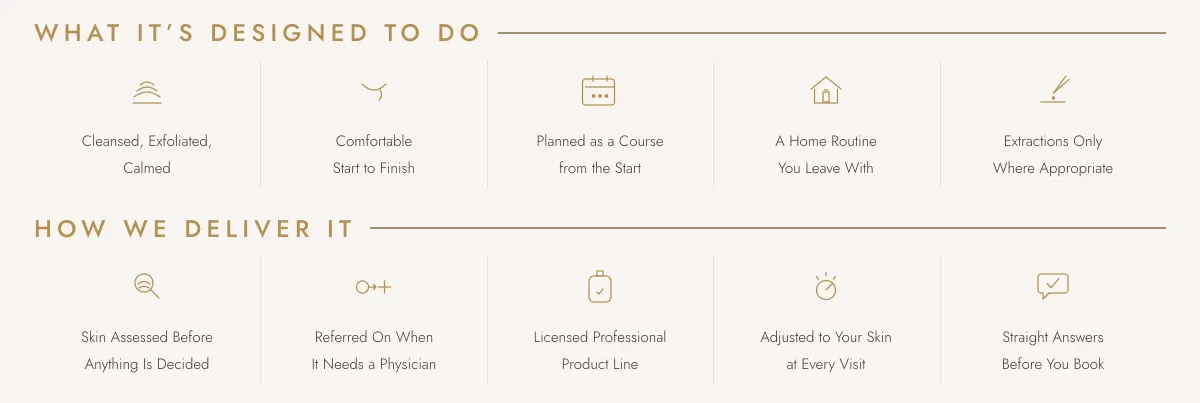
Think of it as a facial with one job, and a plan behind it.
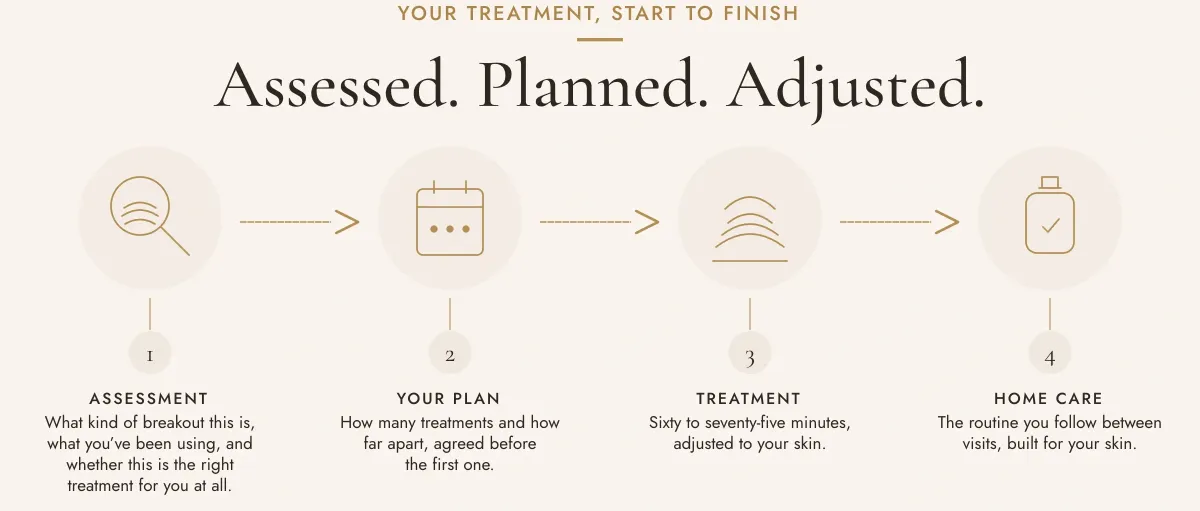
Here's what actually happens. Your skin is assessed first: what you've been using, how your skin behaves, and what kind of breakout we're looking at. Then the treatment is built for it. Deep cleansing, exfoliation chosen for your skin, extractions where they're appropriate, high frequency or blue LED where your skin calls for it, and products selected to reduce congestion and calm irritation. The appointment runs 60 to 75 minutes.
Acne starts inside the pore. Oil, dead skin cells and bacteria get trapped, and what shows up on the surface is a blackhead, a whitehead, a pimple or an inflamed spot. An acne treatment works on that directly.
The plan runs past today's breakout. A course is 4 to 8 treatments, depending on how much is going on, every 2 to 4 weeks to start, alongside a home routine built for your skin. Once things are under control, visits move to every 4 to 6 weeks. What we're after is skin that's in better condition over the following months, and the honest timescale for that is months.
If an acne treatment is the right thing for you, we'll tell you. If what you need is a dermatologist, we'll tell you that too.
What is an acne treatment?
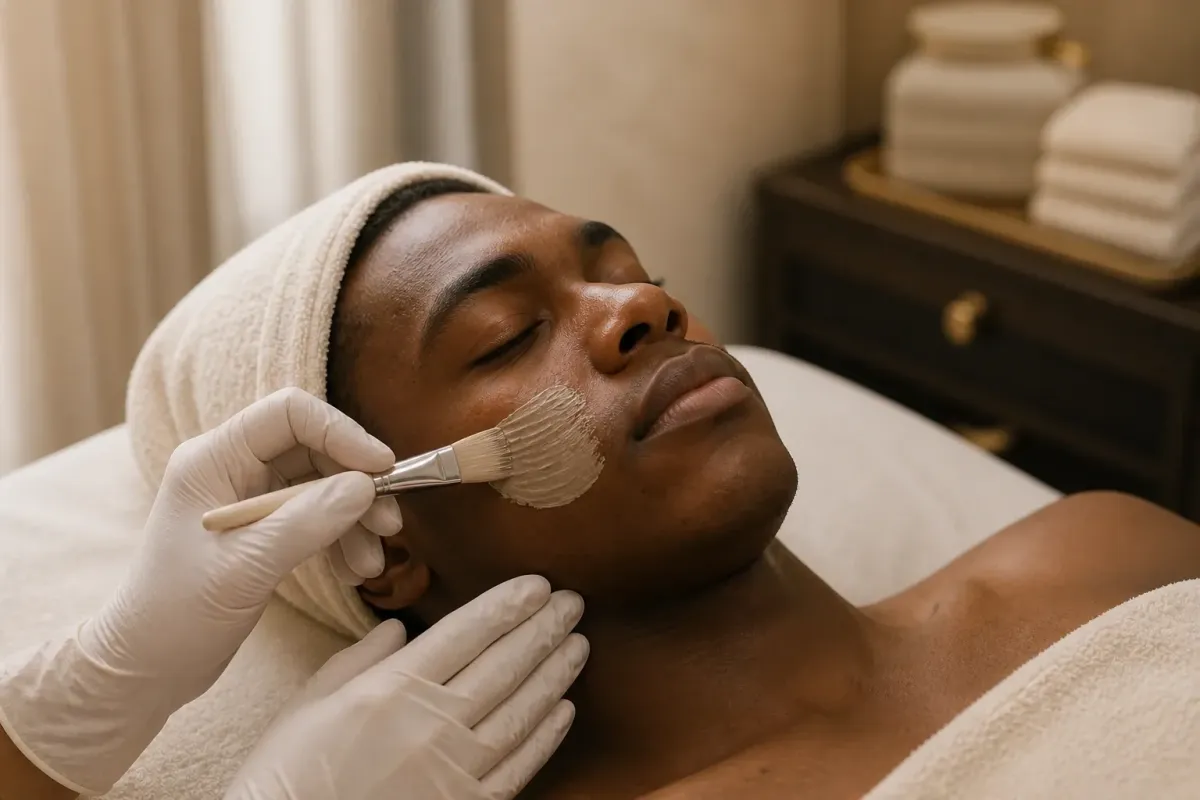
The appointment runs 60 to 75 minutes, and it follows the same shape each time, with the detail adjusted to your skin that day:
Consultation and skin analysis: your acne, your skincare routine, your lifestyle, and what you want out of a course of treatment
Deep cleansing, to clear the surface properly before anything else happens
Exfoliation, chosen for your skin. This may tingle
Extractions, where clearing a clogged pore safely is appropriate
High frequency or blue LED, depending on your skin that day. Both are painless
A calming mask, then serums, moisturizer and SPF chosen for you
The two peels
Two professional peels sit inside the protocol where the skin calls for them: a GlyMed+ AHA Peel and a GlyMed+ 20% Salicylic Peel. A peel is chemical exfoliation at professional strength. A solution goes onto cleansed skin, stays on for a controlled time, and loosens the bonds holding dead cells to the surface so they shed faster than they would on their own.
Depth is the whole conversation. A light peel works on the surface and you walk out looking fine. Go deeper and you get more change, and visible flaking for several days. Whether a peel belongs in your treatment at all, and which one, is a clinical decision made on the day.
The products and devices
Riviera works with the GlyMed+ Professional line, available to licensed professionals rather than over a counter: cleansers, an enzyme exfoliator, a deep pore masque, a barrier balm, a clarifier and SPF. The devices are a Nuderma high frequency unit and a Celluma blue LED panel.
The type of acne you have sets the plan
Acne has a version that responds well to this kind of treatment, and a version that no facial is going to fix. So the first thing that happens here is working out which one you have.
Blackheads, whiteheads, congested pores, oily skin and mild to moderate inflammatory breakouts respond to it, and a course can make a real difference.
Deep cystic acne is a different problem. So is widespread scarring, and so is acne driven by something a prescription is the answer to. When that is what we are looking at, we say so at the consultation and refer you on. Where your physician is happy with it, we keep working with you alongside your dermatologist. We do not extract or drain cysts. What we can do is support the skin barrier and help a breakout settle faster while the prescription does its job.
The person making that call is Anna Nicolardi, L.E., Riviera's Director of Aesthetics, a licensed esthetician in New York State for more than 13 years whose work covers chemical peels, microneedling, dermaplaning, and laser and light therapies. She is also a licensed Aesthetics Instructor, and has spent over 5 years training other estheticians.
What you are paying for here is that judgment. The products and devices are available to licensed professionals generally. Knowing which of them belongs on your skin today, and knowing when the answer is a referral, is the part that varies.
How many treatments will you need?
4 to 8 treatments, every 2 to 4 weeks to start, depending on the severity of your acne.
What one treatment does, and what follows
Skin that feels cleaner
Less oily
Smoother to the touch
Often calmer over the next several days
Some clients get a temporary flare in the days after a treatment as existing congestion comes to the surface. Not everyone does, and it's usually short-lived. We can't tell you in advance whether it will happen to you.
Mild redness for several hours is normal, and so is some tenderness where extractions were done.
What the course is for
That runs alongside a home routine built for you.
Most clients begin seeing noticeable improvement after 3 to 6 treatments. Once things are under control, visits move to every 4 to 6 weeks.
What an acne treatment won't fix
Straight answers, because the wrong treatment is worse than no treatment. What you do at home is part of this: a course runs alongside a home routine built for you. It also works with prescription treatment. If you're on something from a physician, tell us, and we adapt around it.
It does not remodel scarring left behind by acne
Textural scarring sits deeper than this treatment reaches. Clearing active breakouts is one job and treating what they left behind is another, so ask about scarring at consultation and we'll tell you what we'd recommend for it, here or elsewhere.
It is not a treatment for severe or cystic acne
Severe cystic acne needs a physician, and so does acne with a medical driver behind it. Hormones and certain medications are real causes, and neither is an esthetician's to treat. If your pattern points there, we say so. Where you are already under a dermatologist's care, we can often work alongside them. What we cannot do is treat the acne itself.
One thing worth knowing before you book two treatments
Chemical exfoliation changes what your skin can safely tolerate next, and the peels above are chemical exfoliation. A peel needs to be spaced away from IPL, radiofrequency, microneedling, laser and waxing, in both directions.
We sequence this for you at consultation. It's one of the things that goes wrong when treatments get booked off a menu.
Who is a good candidate?
It depends on what kind of acne you have, which is what the consultation is for. An acne treatment suits you if you have:
Blackheads or whiteheads
Congested pores
Oily skin
Mild to moderate inflammatory breakouts
Adult acne
Discoloration left behind by past breakouts, as part of a treatment plan
What gets built depends on what we find. The exfoliation, the extractions, the peels and the products all change with the kind of breakout in front of us.
Who may not be?
Some things mean we won't treat you that day:
An active cold sore
A contagious skin infection
Open wounds on the area
Severe sunburn
A fever or a contagious illness
An active allergic skin reaction
Currently using isotretinoin, sometimes sold as Accutane
Currently taking oral steroids
What gets built depends on what we find. The exfoliation, the extractions, the peels and the products all change with the kind of breakout in front of us, and some medications and recent treatments change them again. Isotretinoin decides the most: what we can do while you're on it, or soon after, depends on it. So tell us what you take and what you've had done recently. If we don't think this will give you what you're after, or if your acne needs a dermatologist, we'll tell you before you commit to a course.
What to expect during and after your treatment
The treatment is designed to be comfortable, and the parts you feel are short.
Extractions are the one part you'll feel. Clearing a clogged pore involves brief pressure and occasional brief discomfort. It should not be more than that, and we work within your comfort level. Exfoliation can tingle, depending on what is used and how your skin is that day.
High frequency and blue LED are both painless. High frequency gives a gentle warmth and a faint buzzing sound. The blue light
panel feels relaxing and there is no discomfort. Then a calming mask, serums, moisturizer and SPF.
Afterward
Mild redness for several hours is normal, and so is some tenderness where extractions were done. Your skin should feel cleaner and smoother.
A temporary purge over the following days happens to some people as congestion clears.
For 24 to 48 hours: leave the over-the-counter retinol and exfoliating products alone, no picking or squeezing, skip heavy sweating and strenuous exercise, and stay out of saunas, hot tubs and steam rooms. Keep out of direct sun and wear SPF daily. Heavy makeup is best left until the following day.
If you are on a prescription retinoid, we will have agreed the plan at consultation, and ask your prescriber before pausing anything they put you on.
Then keep to the home routine we send you with.
Call us if you get severe swelling, blistering, persistent pain, anything that looks like an infection, or an allergic reaction.
Frequently asked questions
Science and safety
Will this actually clear my acne, or is it just a facial?
Honest answer, and it splits two ways.
For blackheads, congestion, oily skin and mild to moderate breakouts, a course of treatments plus a home routine can make a real difference to how your skin behaves. That is what this is for.
For deep cystic acne, extensive scarring, or acne with a medical driver behind it, this is not the treatment and we will say so. Those need a physician. We can work alongside one, and often do. We do not extract or drain cysts.
Be careful with anyone promising a result before they have looked at your skin.
Is it safe?
For most people, yes, and we go through your history before we start.
Active infections, cold sores and open wounds mean we don't treat you that day, and so do isotretinoin and oral steroids. Pregnancy, recent laser resurfacing or a recent medium to deep peel change what we do rather than whether we do it.
Tell us your medications and any allergies. It changes the plan.
Can I have this if I'm on Accutane?
No, not while you are taking it. Isotretinoin thins the skin significantly, and treating skin in that state risks irritation and scarring. The same applies if you are taking oral steroids.
Tell us at booking either way, including if you have recently stopped, because how long we wait afterward depends on your course and on your skin.
What's in the products you use?
Riviera uses the GlyMed+ Professional line, available to licensed professionals rather than over a counter.
If you have a known allergy, including to fragrance, botanicals or nuts, tell us before we start.
Can I have this while pregnant?
Often yes, with changes, since certain ingredients come out. Tell us at booking so the treatment is built correctly.
Quality and our approach
How is this different from a regular facial?
A facial is built around the condition of your skin generally. An acne treatment is built around clearing congestion and calming inflammation, and it's planned as a course from the start.
The hour still feels like a treatment. What changes is what it's aiming at.
Who performs the treatment?
Riviera's Director of Aesthetics is Anna Nicolardi, L.E., a licensed esthetician in New York State for more than 13 years and a licensed Aesthetics Instructor who has spent over 5 years teaching advanced technique to other estheticians.
Do you say no?
Yes. If your acne needs a dermatologist, we say so at the consultation, before you commit to a course.
Do you sell courses, or single treatments?
Both, and for acne we usually recommend a course.
Where the acne calls for it we run a structured program: a full switch to non-comedogenic products, and a run of treatments over 6 to 12 weeks combining salicylic peels, blue light, extractions where they are appropriate, and IPL where it is warranted, with pre and post care throughout.
It starts with an in-person diagnostic facial, so we know your skin type and can work out what is triggering your breakouts. It asks something of you at home, and that is the part that decides whether it works.
Do I need to do anything before I come in?
Yes, and it makes a difference. For 24 to 48 hours beforehand, stop over-the-counter retinol, exfoliating acids and facial scrubs. No waxing or threading, no tanning, and keep out of strong sun. If you are on a prescription retinoid, tell us and ask your prescriber before pausing it.
Tell us if you have recently started an acne medication, if you are taking isotretinoin, if you have had a recent laser treatment or chemical peel, if you are pregnant or breastfeeding, or if you have any allergies or skin sensitivities.
And please don't pick at your blemishes before your appointment.
Results and what to expect
Will it make my skin worse before it gets better?
It might, briefly. Some people get a purge in the days after a treatment as existing congestion comes to the surface. Not everyone does, and it's usually short-lived.
How many treatments will I need?
It depends on the severity of your acne. Most clients benefit from a series of 4 to 8, spaced every 2 to 4 weeks to start.
Most begin seeing noticeable improvement after 3 to 6 of them, with progress continuing over several months.
How soon will I see something?
Many clients notice their skin feels cleaner and less oily immediately after a treatment. Inflammation often begins improving over the next several days.
Reductions in breakouts happen gradually, with consistent treatments and home care.
What happens once it's under control?
Maintenance treatments every 4 to 6 weeks are designed to help keep things that way, alongside the home routine.
Will I be red? Can I go back to work?
Mild redness for several hours, and some tenderness where extractions were done. Most people go straight back to their day.
RIVIERA AESTHETIC
By emailing or texting Riviera Aesthetic, you consent to being contacted by phone, email and/or SMS. If you no longer wish to receive any messages, let us know by replying STOP or UNSUBSCRIBE, or by calling us on +1-516-266-2996. Read our Privacy Policy here. You can read our Payment & Refund Policy here.
© Riviera Aesthetic 2026 All Rights Reserved.