
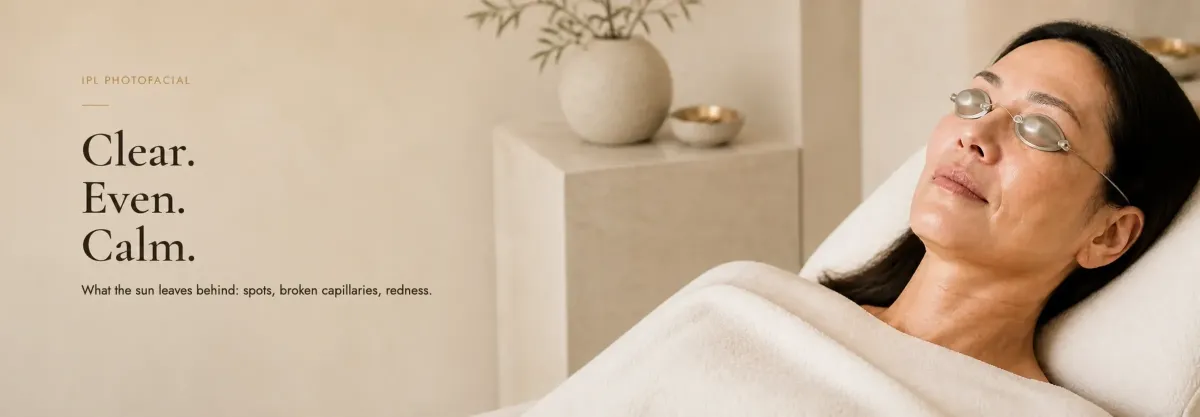
IPL Photofacial
Sun damage and redness, lifted by light
Pulses of light, aimed at what makes skin look older than it is.
Here's what actually happens. Sun damage, age spots, broken capillaries and background redness all carry either pigment or blood, and both absorb light. The light is absorbed by the pigment and the vessels you want gone, and it passes through everything around them. The target heats and is damaged, and the skin beside it is left alone. Your body then clears the damaged cells over the following weeks.
The front desk version: IPL tells your body which pigment and which redness to remove. Your body does the cleanup, and the surrounding skin is left unharmed. The result arrives over the following weeks, after you have left the room.
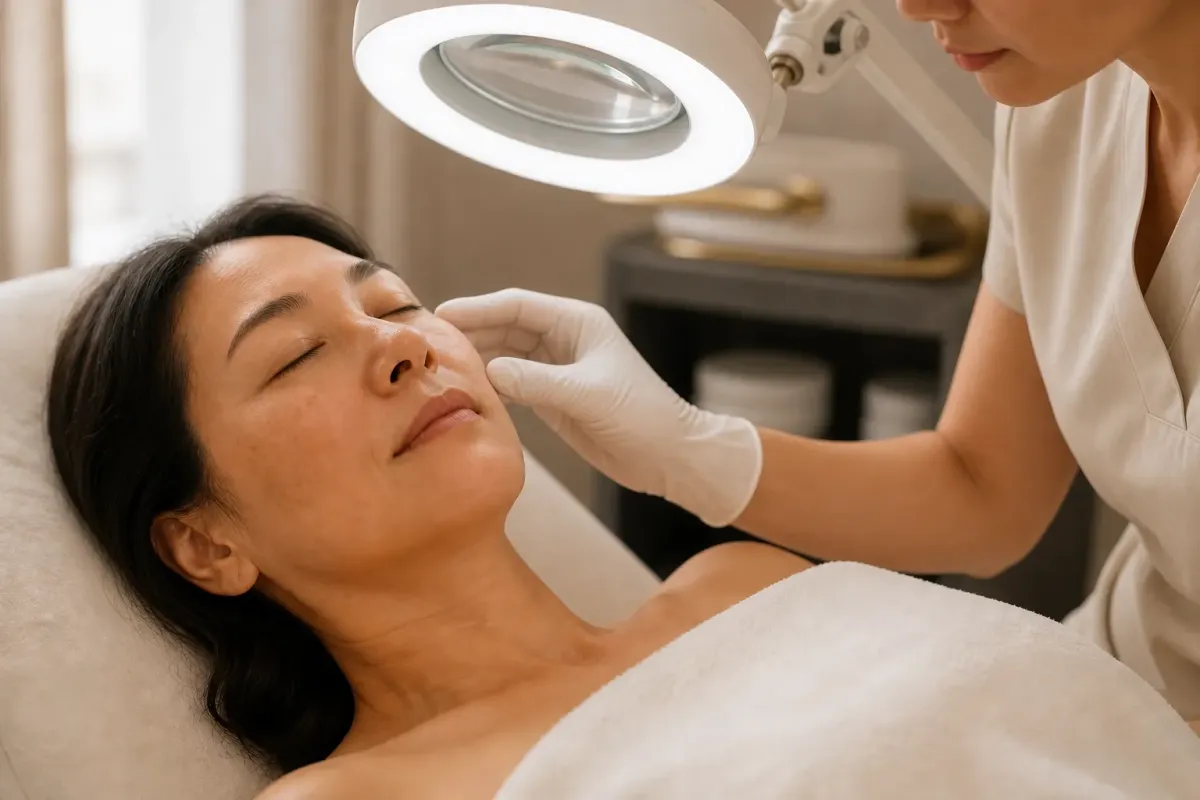
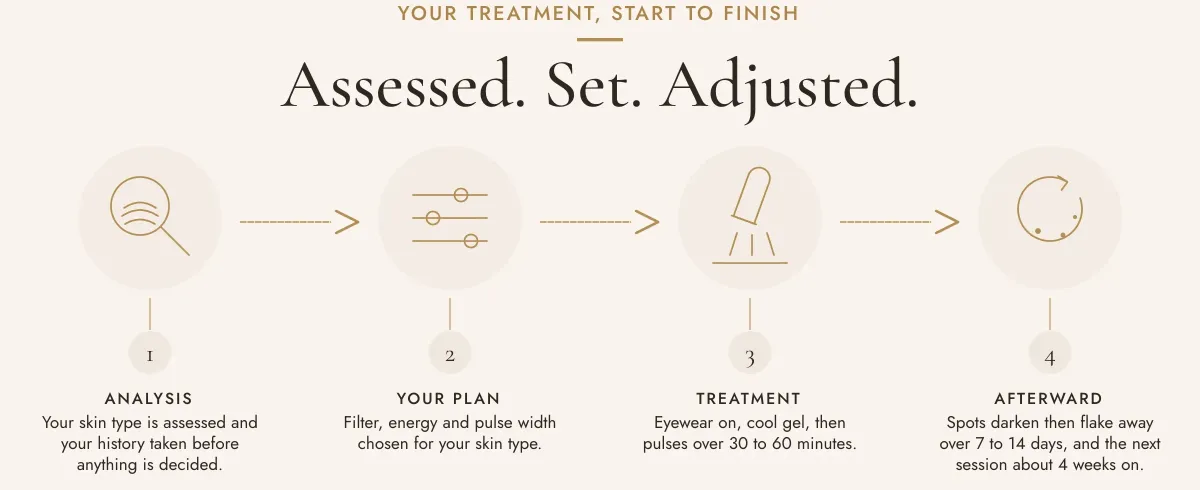
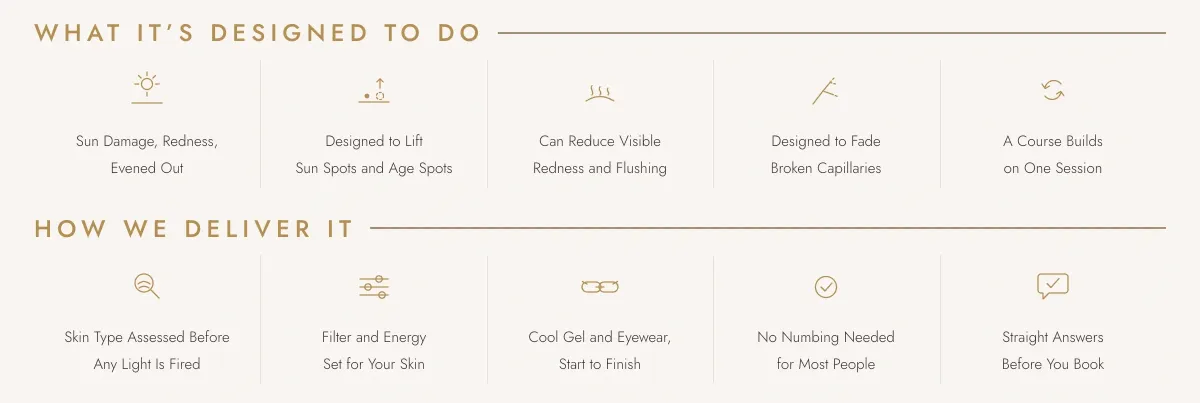
Every appointment starts with a consultation and skin analysis, because light behaves differently on different skin. Your skin is cleansed, protective eyewear goes on, and cool gel is applied. Then a series of pulses, each one a quick snap of light, over 30 to 60 minutes depending on the area. Afterward your skin feels warm, like a mild sunburn, and treated spots darken before they flake away over 7 to 14 days.
If an IPL photofacial is the right treatment for you, we'll tell you. If something else is, we'll tell you that too.
What is an IPL photofacial?
IPL stands for intense pulsed light. An appointment runs 30 to 60 minutes depending on the area, and the light is absorbed by two things, pigment and blood. It works on:
Sun spots and freckles, including the flat brown marks known as solar lentigines
Age spots and the general mottling that comes from years of sun
Broken capillaries, and the fine surface veins known as telangiectasia
Background redness and facial flushing, including the redness that comes with rosacea
Red marks left behind by acne
A dull complexion, on the face, neck, chest or hands
The filters
A laser fires one wavelength of light. IPL fires many at once, and a filter cuts off everything below the level we want. The light is absorbed by melanin, the pigment in a brown spot, and by hemoglobin, the blood in a broken capillary. Both convert it into a small amount of heat. The heat damages the target and leaves the skin around it alone, and your body clears the damaged pigment over the following weeks.
The filter is chosen for what we are treating. 530nm covers pigmentation and vascular work. 430nm is used for acne and superficial vascular lesions. 640nm is for hair removal, which is a separate treatment and a separate conversation.
The device
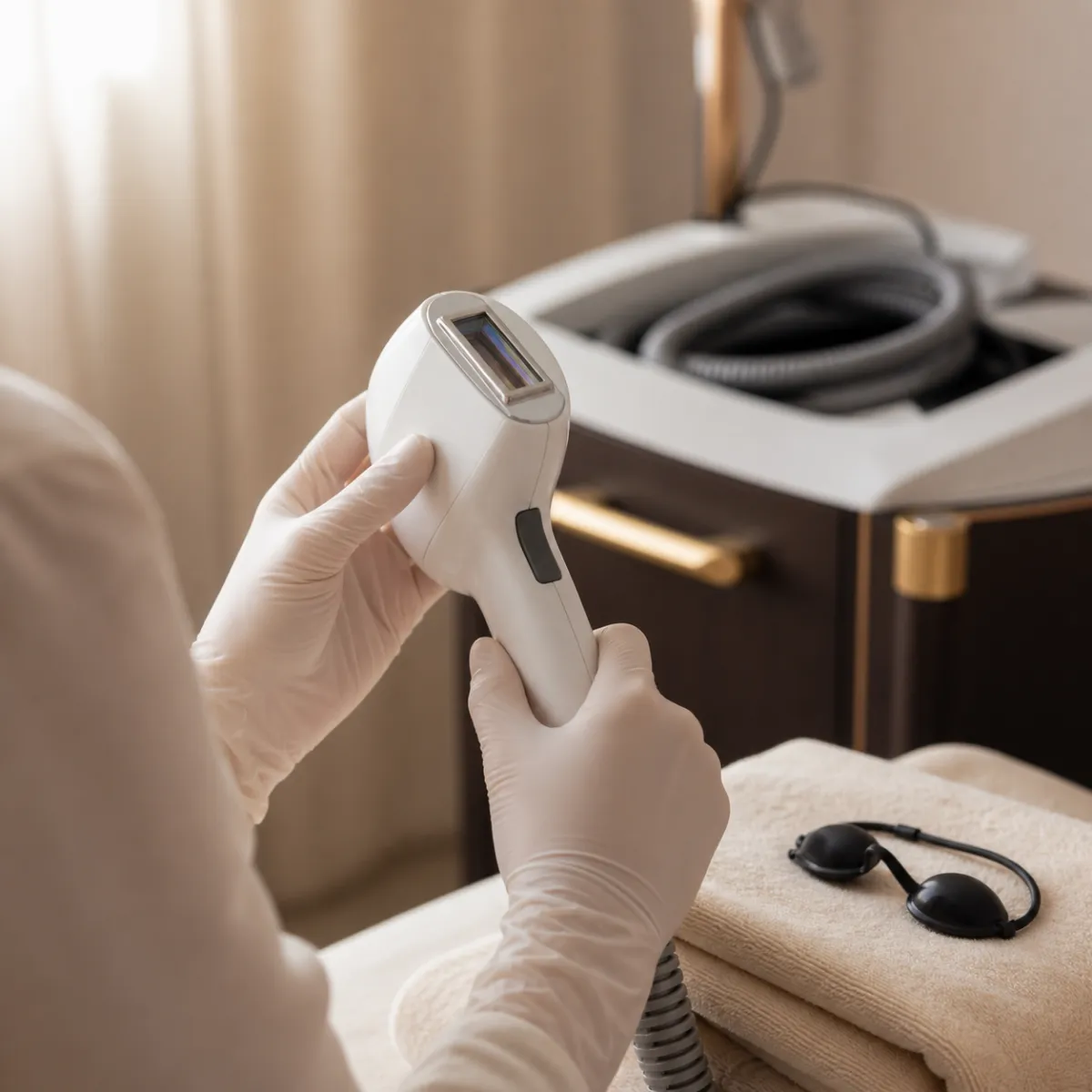
Riviera uses the Onyx Expert IPL, with interchangeable filters at 430nm, 530nm and 640nm. Energy, pulse width and filter are set for each client rather than run off a preset, and that decision is made at your consultation.
Your skin type sets the strength of the light
The usual way to buy IPL is off a menu, and the machine is the story.
IPL works by heating pigment, and your skin contains pigment. On the right skin at the right setting, the light finds the sun spot and nothing else. On the wrong skin, or at the wrong setting, it can leave a burn, a pale patch, or a darker patch that was not there before.
Anna Nicolardi, L.E., is Riviera's Director of Aesthetics. She has been a licensed esthetician in New York State for more than 13 years, is licensed in laser and light therapies, and is a licensed Aesthetics Instructor who has spent over 5 years teaching advanced technique. The person setting the energy on your face is the person other estheticians learn from.
Three things happen here before any light is fired. Your skin type is assessed on the Fitzpatrick scale, the standard measure of how skin responds to light. Anything suspicious goes to a dermatologist first, because IPL can destroy the thing a dermatologist needed to see. And a test spot is fired at the energy we intend to use, so the setting is chosen for your skin.
And sometimes we say no: where a skin tone carries more risk of a pigmentation change than the treatment is worth, we say so.
How many sessions will you need?
3 to 5 sessions, about 4 weeks apart, depending on how much sun damage or redness there is.
What you see after one session
Spots that darken, then flake away
Usually clearer skin underneath
Redness starting to settle
Capillaries starting to fade
Treated brown spots darken first, taking on a speckled, ground-coffee look. Over roughly 7 to 14 days they flake away on their own. That is the treatment working, and it is visible for up to two weeks.
Redness moves on a different clock, usually starting to improve over the first 1 to 2 weeks without the darkening stage.
What the course is for
Most people see real change after 2 or 3 sessions
.
Results can hold 6 to 12 months or longer with daily sunscreen and skincare you keep up, and a maintenance session every 6 to 12 months handles new sun damage.
What IPL will not do
Straight answers, because the wrong treatment is worse than no treatment. IPL works on color: brown, red, and the general mottling that comes from years of sun. That is what the light can find, and on the right candidate it finds it well.
It does not work on texture or structure
Deep lines, acne scarring, enlarged pores and skin laxity are problems of shape, and light aimed at pigment does nothing for them. Microneedling works further down and is often the better answer.
It is not a treatment for skin disease
Rosacea is a chronic medical condition. IPL can reduce the visible redness and broken capillaries that come with it, and it leaves the underlying condition where it was. If you have not been diagnosed, see a physician first.
One thing worth knowing before you book two treatments
IPL changes what your skin can safely tolerate, and other treatments change what IPL can safely be fired at. It has to be spaced away from peels, retinoids, microneedling, radiofrequency, laser, waxing and injectables, in both directions.
We sequence this for you at consultation. It is one of the things that goes wrong when treatments get booked off a menu.
Who is a good candidate?
Color, which is the honest answer and also a useful one. IPL suits you if what is bothering you on your skin is:
Sun damage and sun spots
Age spots and freckles
Uneven skin tone
Redness and facial flushing, including the redness that comes with rosacea
Broken capillaries and thread veins
Red marks left behind by acne
A dull complexion you want brightened
Who may not be?
Some things mean we will not treat you at all:
Pregnancy
An active cold sore, or any skin infection in the area
Open wounds in the area
Severe sunburn, a recent tan, or self-tanner on the area
Active skin cancer in the treatment area
A mole or a pigmented lesion that has changed and has not been seen by a dermatologist
Epilepsy, because the flashing light can trigger a seizure
A pacemaker or an implanted defibrillator
A tattoo or permanent makeup in the area we would be treating
Diabetes that is not well controlled
Lupus, or other photosensitive autoimmune conditions
Systemic or oral corticosteroids
The best candidates have lighter skin with visible pigment or redness, because the light needs a clear difference between the target and the skin around it to work safely. Some medications, medical conditions and recent treatments change the settings, move a session, or mean we ask your physician first. Where the risk of a lasting pigmentation change outweighs what IPL would give you, we say so at consultation. So tell us what you take, what you've had done recently and where you've been in the sun.
What to expect during and after your treatment
Most people find it very manageable, and we do not use numbing cream. That is deliberate. Feeling the pulse is how we know the setting is right for your skin, so we need you able to tell us what you are feeling as we go.
The sensation is a quick snap, like being flicked with a rubber band, followed by a moment of warmth. Then the handpiece moves and it happens again. There is a click with each pulse, and cool gel on your skin the whole time to take the edge off.
You wear protective eyewear from start to finish. So does whoever is treating you.
Afterward
Your skin feels warm, like a mild sunburn, and it looks flushed for a few hours. Some mild swelling is normal, particularly on the cheeks and under the eyes. Then the treated spots darken and flake away over 7 to 14 days.
For 48 hours: no hot showers, saunas, steam rooms, hot tubs, or exercise heavy enough to make you sweat.
For 7 days: no retinol, no exfoliating acids, no scrubs, and leave the darkened pigment alone rather than picking at it. Broad-
spectrum SPF 30 to 50 every day, and stay out of the sun while your skin is healing.
Call us if you get blistering, severe swelling, increasing pain, anything that looks like an infection, or redness lasting longer than expected.
Frequently asked questions
Science and safety
Does IPL actually work, or is it just an expensive glow?
It works on the right person, for the right thing, and it is worth being specific about both.
The published research is positive, and it is qualified. Reviews of IPL for redness and for sun damage consistently report improvement, and the same reviews say the underlying studies are mostly small and poorly controlled. The largest independent assessment of light-based treatment for facial redness rates the evidence as low quality while still finding it effective.
We would rather tell you that than quote you a percentage. What it means in practice: if you have visible brown or red sitting on lighter skin, this is one of the better treatments available for it. If you are hoping it will do something about texture, lines or pores, it is the wrong treatment and we will say so.
What is the difference between IPL and a laser?
A laser produces one wavelength. IPL produces many at once, and a filter cuts off everything below the level we want for what we are treating.
That makes IPL more flexible across pigment and redness in a single session. It also makes the settings matter more, because a broad spectrum reaches more things in your skin than a single wavelength does.
Is it safe?
For the right candidate, treated at the right settings, yes. Both parts of that sentence are doing work.
IPL heats pigment, and skin contains pigment. On the wrong skin type or at too high an energy, it can cause a burn, a blister, or a lasting change in skin color. That is why the assessment happens before the treatment and why we turn some people away.
We go through your health history, your medications and your sun exposure before anything is fired.
Can I have IPL if I am pregnant or breastfeeding?
Pregnancy is on the list of things that mean we will not treat you, and we will happily see you afterward. If you are breastfeeding, tell us at booking and we will advise.
I've got a mole I've been meaning to get looked at.
Get it looked at first, and then come to us.
IPL destroys pigment. Firing it at a lesion nobody has assessed removes the thing a dermatologist needed to see. We will refer you before we treat around it.
Quality and our approach
Is all IPL the same?
No, and the variable is smaller than the machine.
Every IPL fires filtered light from a flash lamp. What changes is who decides your skin type, who sets the energy, and who is willing to tell you that your skin is not right for it.
Who performs the treatment?
Riviera's Director of Aesthetics is Anna Nicolardi, L.E., a licensed esthetician in New York State for more than 13 years, licensed in laser and light therapies, and a licensed Aesthetics Instructor who has spent over 5 years teaching advanced technique to other estheticians.
What device do you use?
The Onyx Expert IPL, with interchangeable filters at 430nm, 530nm and 640nm. The filter, the energy and the pulse width are set for each client rather than run off a preset.
Do you say no?
Yes, and IPL is the treatment we say it about most.
Certain skin tones carry a real risk of a lasting pigmentation change from IPL. Where that risk outweighs what the treatment would give you, we tell you at consultation. Some people leave with a different recommendation and some leave with none.
Why don't you promise dramatic results like I see elsewhere?
Because a photograph of someone else's face tells you nothing about yours.
IPL results depend on your skin type, how much damage is there, how many sessions you complete and what you do about sun afterward. We would rather set the expectation accurately at consultation and have you pleased at session four.
Results and what to expect
How many sessions will I need?
Most people need 3 to 5 sessions, about 4 weeks apart. Most notice real change after 2 or 3, with the full result once the course is done.
The number depends on how much sun damage or redness is there and what you want out of it.
My spots have gone darker. Is that wrong?
That is the treatment working, and it is the thing we most want you to know before you book.
Treated pigment darkens over the following days and takes on a speckled, ground-coffee look. Over roughly 7 to 14 days it flakes away and the skin underneath is usually clearer. Leave it alone while it does, and keep it out of the sun.
Redness behaves differently and usually just improves over the first 1 to 2 weeks.
Is there downtime?
Most people go straight back to their day. You will be warm and flushed for a few hours.
The visible part is the darkened pigment, and that is up to 2 weeks of it. Worth knowing before you book something four days out.
How long do the results last?
6 to 12 months or longer, depending on how much sun you get and how consistent you are with SPF and skincare.
New sun damage arrives throughout your life, so a maintenance session every 6 to 12 months keeps ahead of it.
Do I need to do anything before I come in?
Yes, and this one matters more than it does for most treatments.
For 2 weeks: no sun on the area, no tanning beds, no self-tanner. A tan makes your skin absorb the light where you don't want it to.
For 5 to 7 days: stop retinol and prescription retinoids, exfoliating acids and facial scrubs.
For 1 week: no waxing, no hair-removal creams, and no chemical peels or aggressive exfoliation on the area.
Come in with clean skin, free of makeup, sunscreen, lotion and self-tanner.
Tell us if you're pregnant, if you've started a new medication, if you take blood thinners or anything that makes you sensitive to light, if you get cold sores, if you have diabetes, an autoimmune condition or a history of keloid scarring, or if you've had laser or a peel recently.
Does it hurt?
Most people find it very manageable, and we do not use numbing cream. The sensation is a quick snap, like being flicked with a rubber band, then a moment of warmth. Cool gel stays on your skin the whole time.
RIVIERA AESTHETIC
By emailing or texting Riviera Aesthetic, you consent to being contacted by phone, email and/or SMS. If you no longer wish to receive any messages, let us know by replying STOP or UNSUBSCRIBE, or by calling us on +1-516-266-2996. Read our Privacy Policy here. You can read our Payment & Refund Policy here.
© Riviera Aesthetic 2026 All Rights Reserved.