
Facials and Chemical Peels
Clearer, calmer, better hydrated skin
Think of it as a spa treatment with real skincare behind it.
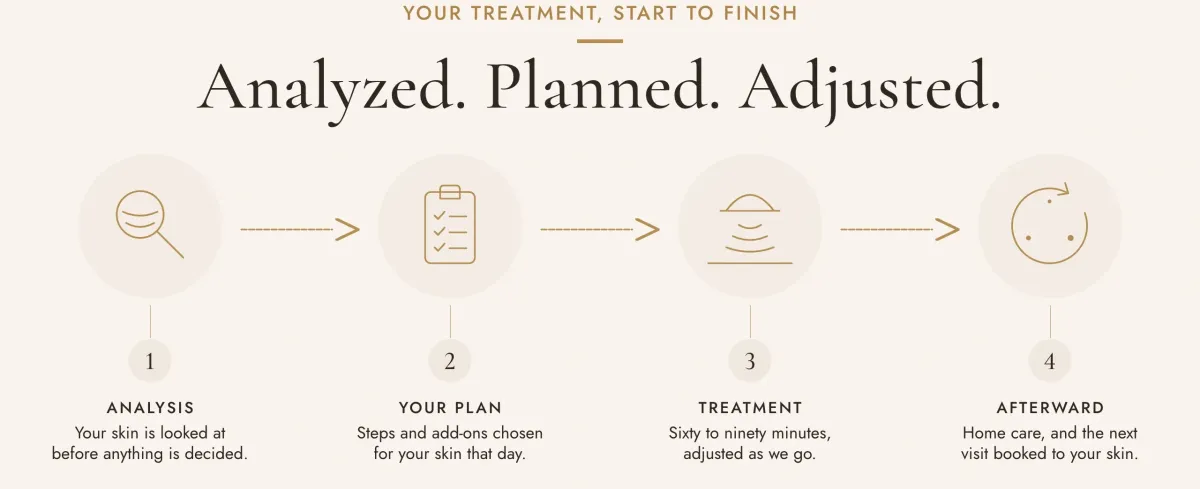
Here's what actually happens. Your skin is analyzed. Makeup and buildup are cleansed away. Dead skin is gently exfoliated. Extractions are performed if they're needed. Your face, neck and shoulders are massaged. Then it finishes with masks, serums and moisturizer chosen for you. Every step is adjusted to your skin that day, which is why the same client can have a different treatment in November than in June.
A facial at Riviera is a deep clean, a workout and a reset for your skin, and it happens while you lie on a heated bed with warm towels on your face.
Your skin is analyzed first. Then it's cleansed, exfoliated, and treated with professional products chosen for what's actually going on: congestion, dryness, fine lines, pigmentation, or sensitivity. Most people leave with skin that feels softer and looks brighter. No two facials here are the same, because no two people have the same skin. What we do on the day depends on what your skin needs on the day.
If a facial is the right treatment for you, we'll tell you. If something else is, we'll tell you that too.

What is a facial, and where do peels fit?
The core treatment runs 60 to 90 minutes. On top of it sits a set of add-ons, used when your skin calls for them:
Microdermabrasion, a controlled mechanical resurfacing that lifts away the surface layer of dead skin
Chemical exfoliation, using professional acids to loosen and clear dead cells more deeply than a scrub can reach
Dermaplaning, a sterile blade that removes surface dead skin and fine facial hair
LED light therapy, using specific wavelengths of light. There is no heat and most people feel nothing
Oxygen infusion and microcurrent, to hydrate and to lift and firm the look of the skin
Chemical peels
A peel is chemical exfoliation, done at professional strength. A solution goes onto cleansed skin, stays on for a controlled length of time, and loosens the bonds holding dead cells to the surface so they shed faster than they would on their own.
Depth is the whole conversation. A light peel works on the surface and you walk out looking fine. Go deeper and you get more change, and you also get visible flaking for several days. Which one is right for you is a clinical decision, and it depends on your skin, your pigmentation, and what you have on next week.
The products
Riviera works with the GlyMed+ Professional line, available to licensed professionals rather than over a counter, alongside Esthemax and SkinACT oxygen infusion serums. Devices include Celluma LED light therapy, Myolift microcurrent, and a Kendall microdermabrasion unit.
Your skin decides the facial it needs
The usual way to buy a facial is off a menu. Six named treatments, six prices, and you read the descriptions and guess which of your problems is the biggest before you book. Which asks you to diagnose yourself at the booking screen.
Here, you book a facial. What that facial turns out to be is decided after your skin has been looked at, by the person who is about to treat it. A first visit does not end in a peel or in microneedling. Your skin is analyzed, treated at a level it can take that day, and built up from there.
When it is ready for something stronger we say so, and that call is made with your skin in front of us.
Anna Nicolardi, L.E., is Riviera's Director of Aesthetics. She has been a licensed esthetician in New York State for more than 13 years, and her work covers chemical peels, microneedling, dermaplaning, and laser and light therapies.
She also teaches. Anna is a licensed Aesthetics Instructor and has spent over 5 years training the next generation of estheticians in advanced technique.
The person assessing your skin is the person other estheticians learn from.
She also holds a Bachelor's degree in Nutrition and Community Health, which is why a consultation here tends to widen out past product and into how you sleep, what you eat and how much water you drink. Skin does not sit apart from any of it.

How often will you need a facial?
Every 4 to 6 weeks, if you are working on something. Otherwise, whenever you want one.
One facial does something you can see
Brighter skin
Better hydration
Softer texture
Less congestion
Makeup that goes on better
If your facial included extractions you may be slightly red for a few hours, and you may get a small purge as clogged pores clear.
Most clients see the result for 2 to 4 weeks. The glow is strongest in the first 3 to 7 days, and the hydration and texture changes hold on longer.
Correcting something takes a course
Acne, pigmentation, fine lines and rosacea do not move on one treatment. That takes a series, alongside a home routine built for you.
Kept up over months, that is what shifts tone, texture and congestion.
What a facial will not fix
Straight answers, because the wrong treatment is worse than no treatment. A facial works on the surface and just below it. It clears congestion, lifts dead skin, hydrates, and calms things down. That's real, and for a lot of people it's exactly the right answer.
It does not remodel the deeper structure of your skin
Deep acne scarring, established texture change, and lines that sit in your face when it's completely still all need something that works further down. Microneedling may be the better answer, and sometimes it is a dermatologist's.
It is not a treatment for medical skin disease
Severe or cystic acne, a rosacea flare, psoriasis and eczema are conditions we work around rather than treat. If that's what's going on, you need a physician, and we'll say so.
One thing worth knowing before you book two treatments
Chemical exfoliation changes what your skin can safely tolerate next. A peel needs to be spaced away from IPL, radiofrequency, microneedling, laser and waxing, in both directions.
We sequence this for you at consultation. It's one of the things that goes wrong when treatments get booked off a menu.

Who is a good candidate?
Nearly everyone, which is the honest answer and also the least useful one. More specifically, a facial suits you if you have:
Congestion, blackheads or clogged pores
Dryness, dullness or dehydration
Early signs of aging you want to stay ahead of
Uneven tone or pigmentation
Sensitive or reactive skin that needs handling carefully
Skin you're happy with and want to keep that way
Who may not be?
Some things mean we won't treat you that day:
An active cold sore
A contagious skin infection, including impetigo or ringworm
Open wounds or cuts on the area
Severe sunburn
A fever or a contagious illness
An unexplained rash or an active allergic reaction
Recent facial surgery, without clearance from your physician
A treatment gets built for someone in their twenties with breakouts and for someone at 65 maintaining healthy skin, and the two look nothing alike. Some medications, medical conditions and recent treatments change a step or move the timing, and there's usually a version worth having. So tell us what you take, what you've had done recently and what you react to.
If we don't think a facial is going to give you what you're after, we'll tell you before we treat.
What to expect during and after your treatment
The treatment is designed to be a relaxing hour and most people find it is. Warm towels, a face, neck and shoulder massage, and calming scents, on a heated bed.
Extractions are the one part you'll feel. When clogged pores need clearing there's brief pressure and some mild discomfort. It should not be more than that, and it stops when you say so. Exfoliation can tingle, depending on what's being used and how your skin is that day.
Afterward
You sit up with skin that feels clean and hydrated. Some redness and a slight tightness are normal, and both settle. Most people go straight back to their day.
If you had extractions you may see a few small breakouts over the following days as congestion clears, which passes.
For 24 to 48 hours: wear SPF 30 or higher, keep out of the sun, and leave the over-the-counter retinol, acids, benzoyl peroxide, scrubs and cleansing brushes alone. No waxing, threading, dermaplaning or shaving the area. Skip the sauna, the steam room, hot tubs and very hot showers, and give heavy sweating a day. Try not to pick. Makeup is best left off for the rest of the day. If you're wearing it, use clean brushes.
If you are on a prescription retinoid, we will have agreed the plan with you at consultation, and ask your prescriber before pausing anything they put you on.
Call us if you get severe swelling, persistent pain, blistering, or anything that looks like an allergic reaction or an infection.
Frequently asked questions
Science and safety
Is a facial actually doing anything, or is it just relaxing?
Both, and the honest split is worth knowing.
The relaxing part is real and it's deliberate. The part that changes your skin is the exfoliation, the extractions and the actives, and that's what we plan the treatment around. The warm towels are there because the hour should be pleasant, and we're not going to pretend they're doing the clinical work.
Which is also why what goes on your face is decided after your skin has been looked at.
Is it safe?
For most people, yes, and we go through your history before we start.
There are things that mean we won't treat you on the day, and more things that mean we change what we do rather than turn you away.
Active infections, open wounds and cold sores are in the first group. Pregnancy, retinoids, recent injectables and recent laser are in the second.
Tell us your medications and any allergies. It changes the plan.
What's in the products you use?
Riviera uses the GlyMed+ Professional line, available to licensed professionals rather than over a counter, alongside Esthemax and SkinACT.
If you have a known allergy, including to fragrance, botanicals or nuts, tell us before we start.
Can I have a facial while pregnant?
Often yes, with changes. AHA and BHA acids, TCA and Jessner's peels come out. What is left is a treatment designed to be comfortable and to work with the skin changes pregnancy brings, including melasma, hormonal breakouts and increased sensitivity. Tell us at booking so it is built correctly.
What if I'm having cancer treatment, or I've just finished?
Come and talk to us. Skin during and after cancer treatment is often dry, thin and reactive, and it is frequently the point where people are told to avoid facials with no alternative offered.
Our esthetician is trained in oncology esthetics through GlyMed+, and has worked alongside physicians on the skin conditions that come with treatment. We keep oncology-safe options for clients in treatment and for the year afterward, while the body is healing. We may ask for your physician's clearance first.
Quality and our approach
Which facial should I book?
Just book a facial. Which one it turns out to be is decided once your skin has been looked at.
There's a reason for that. Skin changes with the season, with stress, with what you've been using and with where you are in a course of anything else. A treatment picked off a menu three weeks ago is a treatment picked for skin you no longer have.
Who performs the treatment?
Riviera's Director of Aesthetics is Anna Nicolardi, L.E., a licensed esthetician in New York State for more than 13 years and a licensed Aesthetics Instructor who has spent over 5 years teaching advanced technique to other estheticians.
Do you sell courses, or single treatments?
Both. Most people come in for a single facial and book the next one when they are ready.
Where you are working on something specific, acne, pigmentation, fine lines or rosacea, the recommendation is usually a run of treatments every 4 to 6 weeks alongside a home routine. How many, and how far apart, is decided once your skin has been looked at.
Do you say no?
Yes. If a facial isn't going to give you what you're after, or if what you're describing needs a physician, we say so before we treat you.
Some of what people come in asking for is a microneedling answer, an injectable answer, or a dermatologist's answer.
Do I need to do anything before I come in?
Yes, and it makes a difference.
For 24 to 48 hours beforehand, stop over-the-counter retinol, exfoliating acids, scrubs and benzoyl peroxide. No waxing, no tanning, and keep out of strong sun. If you are on a prescription retinoid, tell us and ask your prescriber before pausing it.
Tell us if you've recently had Botox, filler or laser, if you've started a new medication, or if you have a condition that affects how your skin heals.
Results and what to expect
Will one facial fix my skin?
One facial can leave your skin looking noticeably healthier, brighter and better hydrated.
Fixing something is different. Acne, pigmentation, fine lines and rosacea shift over a series of treatments plus a home routine you actually keep up. Be careful with anyone promising you a fix in one session.
How long do the results last?
Most clients see it for 2 to 4 weeks. The glow is strongest in the first 3 to 7 days, and the hydration and texture changes hold on longer.
It depends on your skin type, what you use at home, how much sun you get, and how you're sleeping and eating. Which is a boring answer and a true one.
How often should I come?
Every 4 to 6 weeks.
Will I break out afterward?
You might, briefly. If congestion gets brought to the surface some people get a small purge in the following days. Not everyone does, and it clears.
Will I be red? Can I go back to work?
After a facial, some mild redness for a few hours and then you're fine. Most people go straight back to their day.
RIVIERA AESTHETIC
By emailing or texting Riviera Aesthetic, you consent to being contacted by phone, email and/or SMS. If you no longer wish to receive any messages, let us know by replying STOP or UNSUBSCRIBE, or by calling us on +1-516-266-2996. Read our Privacy Policy here. You can read our Payment & Refund Policy here.
© Riviera Aesthetic 2026 All Rights Reserved.