Non-Surgical Body Contouring
Shape, refined gradually and measured as we go
Diet and weight loss can change the scale without producing the shape you want.
Stubborn areas remain, skin can feel less firm, and cellulite can make contours look uneven. At Riviera Aesthetic, we pair ultrasonic cavitation with radiofrequency in the same session, and add vacuum therapy when the concern is cellulite. It can be useful for refining the areas that tend to hold on longest: the abdomen, the waist and flanks, the hips, the back, the upper arms, and the inner and outer thighs.
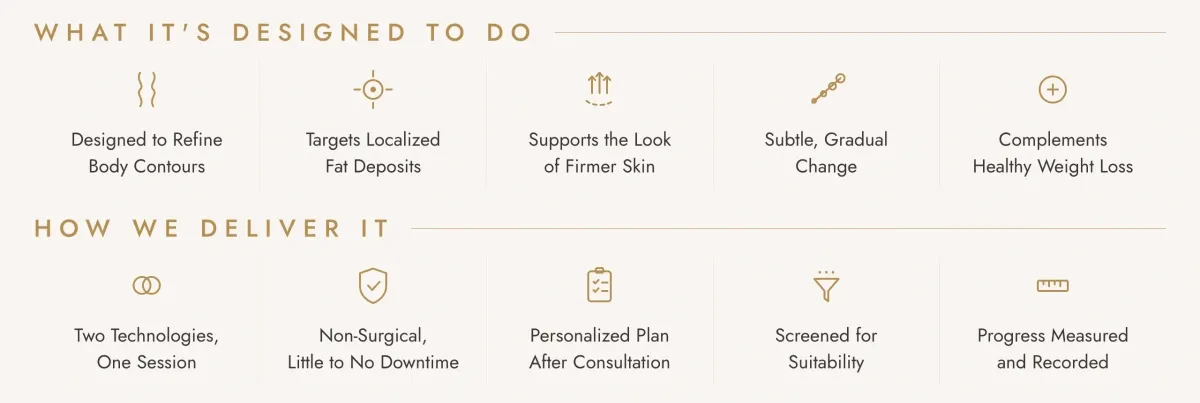
Think of it as the finishing step. The work of weight loss changes your overall size; body contouring is designed to refine what is left, a specific area at a time, gradually, across a course of treatments.
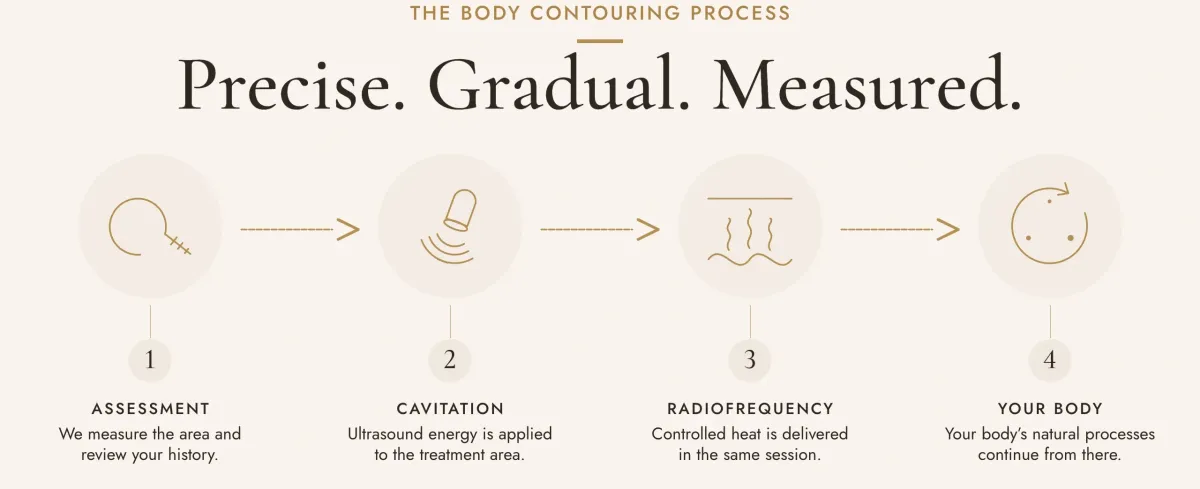
Every course starts with assessment. We measure the area, talk through what a realistic change looks like, and set the number and spacing of sessions for your tissue rather than to a standard protocol. Treatment itself is non-surgical: ultrasound energy and controlled heat are applied to the area, and your body's natural processes continue from there. Which combination of technologies you get depends on what you want to change, and that decision is made at your consultation.
If body contouring is likely to give you a worthwhile improvement, we'll tell you. If it isn't, we'll tell you that too.
What is non-surgical body contouring?
Non-surgical body contouring works on the areas that diet and exercise do not reach. It is used for:
Localized pockets of stubborn fat
Mild skin laxity, meaning skin that has lost some firmness
Uneven contours
The appearance of cellulite
Areas that feel less firm after weight loss
The technologies
Ultrasonic cavitation applies low-frequency ultrasound energy to the fatty layer beneath the skin, intended to disrupt fat cells in the treated area so their contents can gradually be processed by the body. Radiofrequency gently heats the deeper layers of the skin, which is designed to encourage collagen remodeling, the process by which skin rebuilds its own support structure, so skin can look firmer. For stubborn, localized fat, the two are delivered together in the same session.
Where cellulite is the concern, we add vacuum therapy. Controlled suction massages the tissue and supports circulation and lymphatic movement, which can temporarily improve how cellulite looks. Cellulite is normal, and it cannot always be improved completely.
The equipment
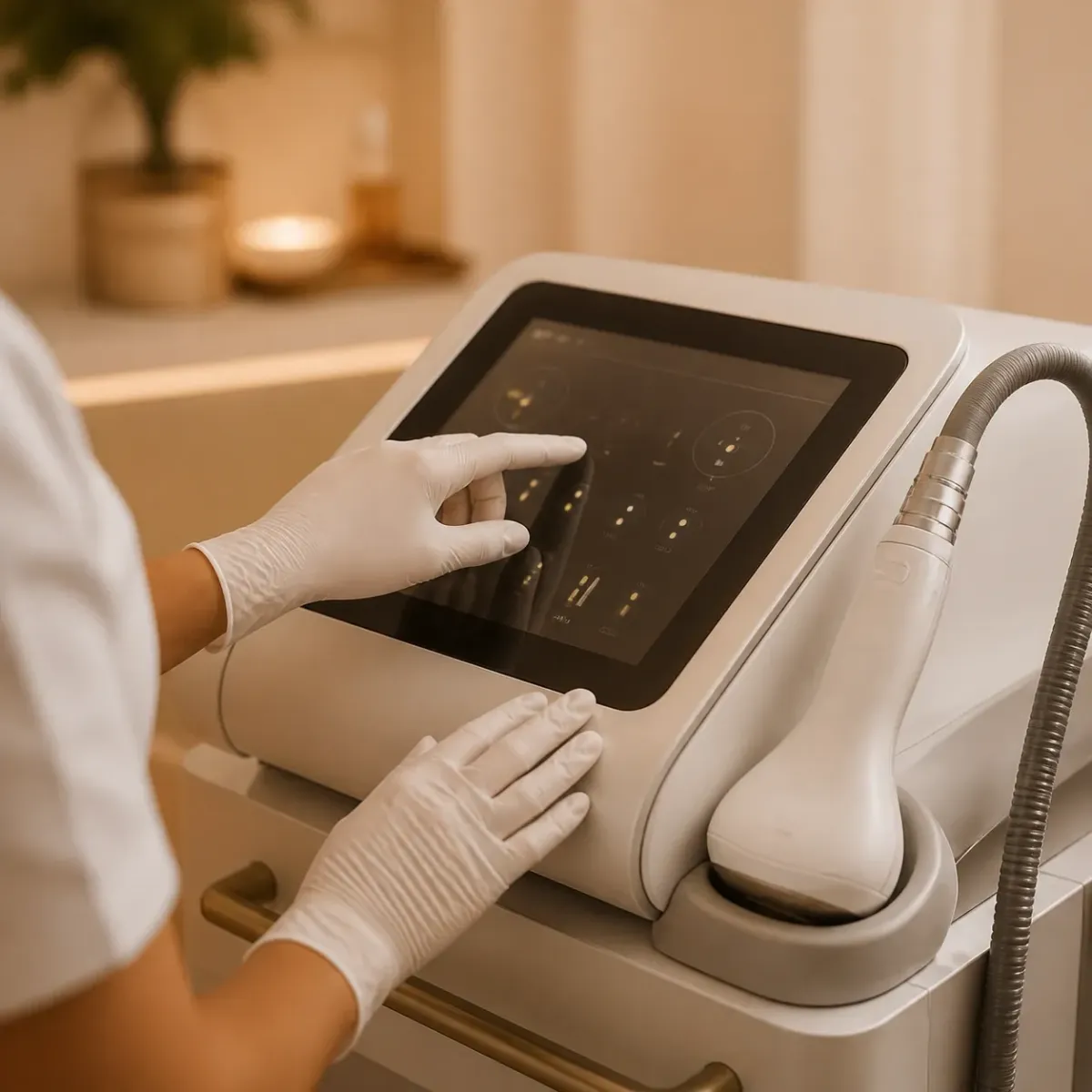
The equipment we use is an EkoShape platform. Different concerns need different technology, so which handpieces we use, and at what settings, is decided at your consultation rather than by running the same treatment on everyone.
How it's delivered is the part that varies
One of the most common assumptions about body contouring is that the machine does the work.
It doesn't, or at least not on its own. Cavitation, radiofrequency and vacuum therapy each act on a different layer of tissue. What changes the result is which of them is used on which area, at what settings, for how long, and whether anyone is checking as they go.
So three things run through every course here:
We run cavitation and radiofrequency together in the same session rather than as separate appointments. That is the combination the research further down this page tested.
We measure. Circumference is recorded at the start of your course, partway through and at the end, so progress is a number rather than an impression, and we adjust the settings as we go.
We screen. If we don't think a course will give you a worthwhile improvement, we say so before you book one.
How this compares with cryolipolysis
Cryolipolysis is the cold-based approach to fat reduction, and it works on the fat layer alone. Most people come to us with two things at once: an area that has not moved with diet and exercise, and skin around it that has lost some firmness. Cavitation is aimed at the first and radiofrequency at the second, which is why the treatment here is built around the combination rather than a single mechanism.
And what you do between sessions counts. Anna Nicolardi, L.E., Riviera's Director of Aesthetics, holds a Bachelor's degree in Nutrition and Community Health, so personalized nutrition planning and consultations are available alongside a course.
How many sessions will you need?
There is no standard number. Yours is set at consultation, based on the area and your goal.
What a single session involves, and what follows
No incisions
No anesthesia
Typically no downtime
Temporary redness, warmth, tenderness, swelling or mild bruising can occur in the treated area, and usually settles quickly.
Some people notice an early change in circumference or texture after a session. Most of the meaningful change develops across the series and in the weeks that follow, which is normal and worth knowing before you start.
What the course is for
The plan is reassessed as the course goes on, based on the tissue and what you are treating.
Circumference is measured at the first, middle and last session, so you see what the course is doing.
What body contouring will not do
Honest expectations are part of the treatment. For the right candidate, body contouring can refine a localized area, improve the appearance of mild laxity and cellulite, and complement healthy weight loss. The limits below are just as real, and we would rather you know them before you book.
It does not change the number on the scale
Weight loss reduces overall body mass. Body contouring is intended to refine specific areas and improve how they look. You may lose inches without seeing a meaningful change on the scale. It complements healthy weight loss rather than replacing it.
It is not a substitute for liposuction or surgery
It cannot remove large amounts of fat, and it cannot correct significant loose or hanging skin, which may require a surgical procedure. If surgery is what would actually serve you, we will say so.
One condition we are upfront about before you book
Body contouring works alongside what you do between sessions. If you are treating stubborn fat and your diet and activity are not going to change, we will tell you the treatments are unlikely to give you the result you want.
Some clients decide to wait, and that is a reasonable call.
Who is a good candidate?
Results vary from one person to the next and depend on the tissue being treated. Body contouring may suit you if you:
Have localized areas unchanged by diet and exercise
Are at or near a stable weight
Have a mild loss of skin firmness
Have contours that look uneven
Have finished losing weight and want to refine what's left
Want a gradual, non-surgical option
Are willing to support the treatment between sessions
Who may not be?
Treatment may need to be avoided or postponed if you:
Are pregnant
Have an active implanted device such as a pacemaker or defibrillator
Have metal implants within or close to the treatment area
Have open wounds, active infection or compromised skin in the area
Have certain medical conditions affecting circulation, the liver, kidneys or lymphatic system
Have a hernia or structural weakness in the proposed treatment area
Need significant fat removal or surgical correction of excess skin
Each course is tailored to the area and to the result you are working toward, and it is reassessed as the course goes on. Some medications, medical conditions and recent procedures change which areas we treat, which handpieces we use, or how sessions are spaced, and a few mean postponing. So tell us what you take, what you have had done and any condition you are managing. If we don't believe body contouring is likely to help you, we will tell you before we start, and sometimes there are better alternatives.
What to expect during and after your treatment
Most clients find the treatment comfortable.
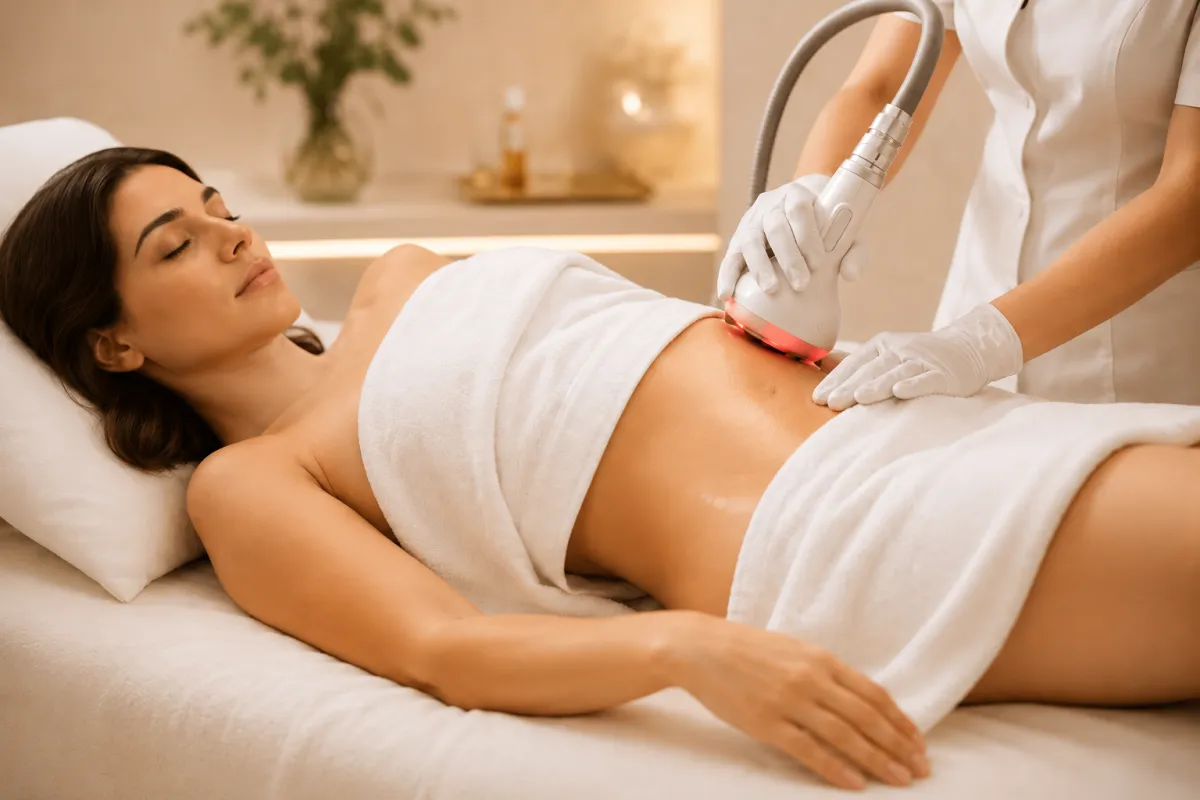
Radiofrequency feels like a warm massage. The handpiece glides over the skin while delivering controlled heat into the deeper layers of tissue, and most clients compare it to a hot stone massage. It should feel comfortable throughout.
Cavitation feels like gentle, massage-like pressure as the handpiece moves over the area, with mild warmth and a light tingling. Some clients notice a high-pitched ringing or buzzing sound during treatment. That is the ultrasound frequency itself rather than anything happening to the tissue, and it stops the moment treatment ends. It surprises people the first time, so we mention it before we begin.
Where we use vacuum therapy, it creates a gentle pulling sensation as the handpiece moves across the area.
The intensity is adjusted throughout the appointment based on your comfort and the area being treated. If anything feels wrong at any point, tell us and we will change it.
Afterward
There is typically no downtime, and most clients return to their normal activities immediately.
Temporary redness, warmth, tenderness, swelling or mild bruising can occur, and usually settles quickly.
Good hydration is generally encouraged before and after treatment, and we give you individualized preparation and aftercare instructions at your appointment.
The science of Non-Surgical Body Contouring
One of the most common questions we get is: "does it actually work?"
It is a fair question. Results are gradual, the industry makes a lot of noise, and the honest answer has conditions attached.
The short answer is: Yes, within limits
That holds if you are the right candidate, if the treatment is matched properly to your tissue, and if you complete a full series rather than a single session.
You can read more about the science here.
"The simultaneous application of ultracavitation and radiofrequency generated a reduction in localized adiposity superior to the isolated use of ultracavitation."
This is the finding behind pairing the two technologies rather than offering cavitation on its own. Researchers divided 45 women into three groups: no treatment, ultrasonic cavitation alone, and cavitation combined with radiofrequency. The combined group showed the greatest reduction in localized fat. The same paper also reported reduced skin flaccidity, meaning skin that sits and looks slacker than it once did.
Source: Da Silva et al (2022): Effects of Ultracavitation and Radiofrequency on Abdominal Adiposity.
"However, the clinical effects are mild to moderate, for example 2 - 4 cm circumference reduction as a sign of subcutaneous fat reduction during total treatment."
An independent review of the field put a number on what "moderate" means: 2 to 4 centimeters of circumference across a full course of treatment. That review is from 2016 and the devices have moved on since, so treat it as a planning range rather than a promise. It's the range we plan around, and it's why your consultation starts with a tape measure.
Case study: body contouring after weight loss
GLP-1 medications have helped many people achieve meaningful improvements in their weight and their health. But rapid or substantial weight loss can leave behind loose-looking skin, uneven contours, or stubborn areas that do not change at the same pace as the rest of the body. Non-surgical body contouring can realistically refine some of what remains.
It is not a substitute for weight loss, and it cannot remove significant excess skin. For the right candidate, it can be a worthwhile finishing step.
Frequently asked questions
Science and safety
What is non-surgical body contouring?
Non-surgical body contouring uses energy-based technologies to refine the shape and appearance of specific areas of the body, without incisions, anesthesia or recovery time.
At Riviera Aesthetic we pair ultrasonic cavitation with radiofrequency, and add vacuum therapy where the concern is cellulite. It is designed to work on shape, firmness and texture rather than on overall body weight.
Which technologies do you use?
Which ones you get depends on what you are treating.
Ultrasonic cavitation applies low-frequency ultrasound energy to the fatty layer beneath the skin, intended to disrupt fat cells in the treated area so their contents can gradually be processed by the body. We use it for localized fat, paired with radiofrequency.
Radiofrequency gently heats the deeper layers of the skin, which is designed to encourage collagen remodeling, so skin can look firmer. It runs alongside cavitation for fat, and on its own or with cavitation where firmness is the concern.
Vacuum therapy uses controlled suction to massage the tissue and support circulation and lymphatic movement, which can temporarily improve the appearance of cellulite. We use it where cellulite is what you want to work on.
Is body contouring scientifically proven?
Partly, and it is worth being precise about what that means.
There is published research supporting the pairing of ultrasonic cavitation with radiofrequency for reducing localized fat, and that pairing is what we run. A 2022 trial found the two delivered together produced a greater reduction than cavitation on its own.
The honest limits. An independent review of the field describes the clinical effects as mild to moderate, and puts the range at roughly 2 to 4 centimeters of circumference across a full course of treatment. The same review states plainly that there is no definitive non-invasive treatment method for cellulite. A 2025 study of 20 women found reductions in that range, with the variation between individuals wider than the average itself.
Protocols are also not standardized across this industry, and no published study uses the exact settings of any one machine.
What that adds up to: for the right candidate who completes a full course, gradual improvement is a reasonable expectation. Nobody should expect a dramatic change. If we don't think you will get a worthwhile improvement, we will tell you before you book.
Is body contouring safe?
Non-surgical does not mean risk-free. Temporary redness, warmth, tenderness, swelling or mild bruising can occur.
Ultrasound and radiofrequency also carry potential risks including burns, blistering or changes in skin color if used improperly, which is why the settings, the operator and the assessment beforehand all matter.
We review your medical history and check for contraindications before any treatment begins.
Can I have treatment while taking a GLP-1 medication?
Many people going through medically supervised weight loss may eventually be candidates. Ideally your weight should be reasonably stable first. We will consider your general health, nutrition, hydration and goals before recommending treatment, and we may suggest waiting.
Quality and our approach
Is all body contouring the same?
No, though the difference is probably not where you would expect it.
Most clinics in this category run similar categories of technology. What varies is which modality gets used on which concern, the settings chosen for your tissue, how long each area is worked, and whether anyone is measuring and adjusting across the course.
That is where we put the effort, and it is why we assess the area and agree a plan before you book a course.
Why don't you offer cheaper body contouring?
Because the result depends on how the treatment is delivered, not on the fact that a machine was switched on.
A proper course means assessing the area first, choosing and adjusting the settings for your tissue, running the technologies in the right combination, and measuring as we go. That takes time, and it takes someone paying attention for the whole appointment.
We would rather run fewer treatments properly than sell a discounted course that is unlikely to give you a worthwhile improvement.
Who is a good candidate?
Body contouring tends to suit people who are at or near a stable weight and want to refine a specific area, rather than people looking to lose weight overall.
It can be worth considering if you have localized areas that have not changed with diet and exercise, a mild loss of firmness in the skin, or contours that look uneven after weight loss.
Results vary from one person to the next and depend on the tissue being treated, which is why we assess the area before recommending a course.
Who may not benefit from body contouring?
Body contouring works differently from surgery. It cannot remove large amounts of fat, and it cannot correct significant loose or hanging skin.
Treatment may also need to be avoided or postponed for medical reasons, including pregnancy, an active implanted device such as a pacemaker or defibrillator, metal implants in or near the treatment area, open wounds or active infection in the area, and certain conditions affecting circulation, the liver, kidneys or lymphatic system.
We review your medical history first. If we don't believe treatment will give you a worthwhile improvement, we will say so.
Why don't you promise dramatic transformations like I see elsewhere?
Because honest expectations are part of the treatment. Body contouring produces gradual refinement, not surgical transformation. It can refine a localized area, improve the appearance of mild laxity, improve the appearance of cellulite and complement healthy weight loss. It cannot produce significant weight loss, replace diet or exercise or medical weight management, remove large amounts of fat, correct significant loose or hanging skin, or replicate liposuction. If we don't believe a non-surgical treatment will produce a meaningful improvement for you, we will tell you.
Results and what to expect
Is body contouring the same as weight loss?
Weight loss reduces overall body mass. Body contouring is intended to refine specific areas and improve how they look. You may lose inches without seeing a meaningful change on the scale.
How many treatments will I need?
The right number depends on the size of the area, the character of the tissue and what you want to achieve. The number and the spacing are set at your consultation, based on the area and what you are treating. Some areas or goals need fewer, some need more. We reassess as we go rather than applying the same protocol to everyone.
When will I see results, and are they permanent?
Some people notice an early change in circumference or texture, but the meaningful results usually develop across the series and in the weeks that follow. Changes can be long-lasting when supported by a stable weight and a healthy lifestyle, but the body continues to age and change. Weight fluctuation can affect the result, and occasional maintenance treatments may be worthwhile.
Does it tighten loose skin, and can it treat cellulite?
Radiofrequency can help improve the appearance of mild laxity by supporting collagen remodeling. It cannot remove significant excess skin, which may require a surgical procedure.
Vacuum therapy and radiofrequency may temporarily improve the appearance of cellulite. Cellulite is normal, and it cannot always be eliminated completely.
Is there any downtime?
Typically none. Most clients return to normal activities immediately. Temporary redness, warmth, tenderness, swelling or mild bruising can occur and usually settles quickly.
RIVIERA AESTHETIC
By emailing or texting Riviera Aesthetic, you consent to being contacted by phone, email and/or SMS. If you no longer wish to receive any messages, let us know by replying STOP or UNSUBSCRIBE, or by calling us on +1-516-266-2996. Read our Privacy Policy here. You can read our Payment & Refund Policy here.
© Riviera Aesthetic 2026 All Rights Reserved.